


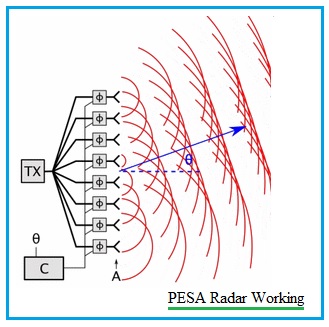
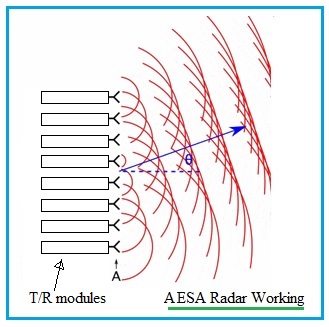
AESA vs PESA radar is a comparison of two electronically scanned array architectures. Both steer a radar beam by controlling the phase across multiple antenna elements, without mechanically rotating the antenna for every pointing change. The main difference is where RF power is generated and controlled: a passive electronically scanned array (PESA) generally uses a centralized transmitter/receiver path, while an active electronically scanned array (AESA) distributes many transmit/receive modules across the aperture.
What Is the Difference Between AESA and PESA Radar?
The difference between AESA and PESA radar is primarily the RF architecture behind the array. The table below summarizes the engineering trade-offs most often considered during radar system design and evaluation.
| Comparison | PESA Radar | AESA Radar |
|---|---|---|
| RF architecture | Centralized high-power RF source distributed through a feed network and phase shifters | Many distributed transmit/receive modules connected to antenna elements or subarrays |
| Beam steering | Electronic phase control across the aperture | Electronic phase and amplitude control with high waveform agility |
| Multifunction capability | Depends on system architecture and scheduler | Well suited to rapid interleaving of search, track and other functions |
| Fault tolerance | Central RF-chain failures can have a larger system-level effect | Individual module failures usually reduce performance gradually rather than stopping the complete array |
| Complexity | Generally fewer active RF modules | More demanding thermal management, calibration, control and integration |
What Is a PESA Radar?
A passive electronically scanned array uses a shared high-power transmitter/receiver architecture. RF energy is routed through a feed network to many radiating elements, while electronically controlled phase shifters adjust the phase at each element to steer the beam. The array itself is called passive because the aperture does not contain a complete active transmit/receive module at every element.
Key Characteristics of PESA
- Electronic scanning: the beam can be redirected rapidly without moving the complete antenna structure.
- Centralized RF generation: a common transmitter feeds the aperture through distribution components and phase shifters.
- Established architecture: PESA technology is used in many ground-based, naval and airborne radar systems.
- System-dependent capability: tracking capacity, waveform agility and scan speed depend on the complete radar design, not only on whether the aperture is PESA.
PESA Advantages and Limitations
PESA can provide accurate electronic beam steering with fewer distributed active modules than an AESA. This may reduce some RF hardware complexity. However, feed-network losses and dependence on a central transmitter can constrain efficiency and fault tolerance. PESA should not automatically be described as single-frequency or limited to one target; those characteristics vary by radar implementation.
What Is an AESA Radar?
An active electronically scanned array contains many solid-state transmit/receive modules distributed across the antenna aperture. A module typically controls one antenna element or a small subarray. Digital control coordinates phase, amplitude, timing and waveform behavior so the radar can steer and schedule beams with high agility.
Key Characteristics of AESA
- Distributed RF modules: power generation and reception are distributed across the aperture.
- Agile beam control: beam position and waveform can be changed rapidly to support search, tracking, mapping and communication functions where the system is designed for them.
- Graceful degradation: failure of individual modules normally causes a gradual reduction in performance instead of a complete loss of the array.
- Calibration and thermal demands: module matching, heat removal, power distribution and control software are important parts of AESA integration.
AESA Advantages and Limitations
AESA architectures can provide high reliability, flexible waveform control, rapid task scheduling and strong electronic counter-countermeasure potential. These benefits come with greater hardware count, calibration effort, cooling requirements and cost. Actual performance depends on aperture size, operating frequency, module output power, noise figure, bandwidth, element spacing, scan angle and signal processing.
Which Is Better: AESA or PESA?
There is no universal answer. AESA is often preferred when multifunction operation, fault tolerance and waveform agility are priorities. PESA can remain practical when the required mission can be met with a centralized RF chain and a simpler active-module architecture. Engineers should compare measurable system requirements rather than selecting only by acronym.
Propagation conditions also matter. Multipath, obstruction and relative motion can change received level and measurement repeatability, so radar evaluations should account for wireless channel fading alongside the array architecture.
- Define the operating frequency and instantaneous bandwidth.
- Set scan coverage, gain, sidelobe and polarization requirements.
- Determine search, tracking and multifunction timing needs.
- Evaluate transmitter power, receiver sensitivity and dynamic range.
- Review thermal, electrical, mechanical and environmental constraints.
- Plan calibration, verification and antenna measurement methods.
Array Antennas and RF Test Support from RF MISO
RF MISO is an RF and microwave antenna manufacturer and supplier supporting antenna research, measurement and system integration. We do not present a complete radar as a single off-the-shelf antenna. Instead, engineers can evaluate relevant components and test solutions according to the required frequency band, gain, polarization, interface and mechanical envelope.
Explore RF MISO array antenna products, planar antennas, waveguide probes and antenna testing capabilities. For project evaluation, provide the operating band, polarization, gain target, beamwidth, scan requirement, connector or waveguide interface, mounting constraints and environmental conditions.
Frequently Asked Questions
Can AESA and PESA radars both steer beams electronically?
Yes. Both architectures use controlled phase relationships across array elements to steer the beam without mechanically rotating the complete aperture for every scan direction.
Is AESA always better than PESA?
No. AESA offers important advantages in agility, redundancy and multifunction operation, but it also introduces more active hardware, thermal management and calibration complexity. The correct choice depends on mission and system requirements.
Why can AESA continue operating after a module failure?
Because RF generation and reception are distributed across many modules. A limited number of module failures normally reduces available aperture performance gradually, although the exact effect depends on array design and fault location.
What antenna parameters matter in radar array evaluation?
Important parameters include operating frequency, bandwidth, polarization, gain, beamwidth, sidelobe level, cross-polarization, element spacing, scan loss, impedance match, power handling and the electrical and mechanical interface.
Discuss Your RF Antenna Requirement
Contact RF MISO with your frequency range and technical requirements for product selection support.
Email: info@rf-miso.com | Phone: +86 28 82695327 | www.rf-miso.com
Post time: Aug-07-2023


