


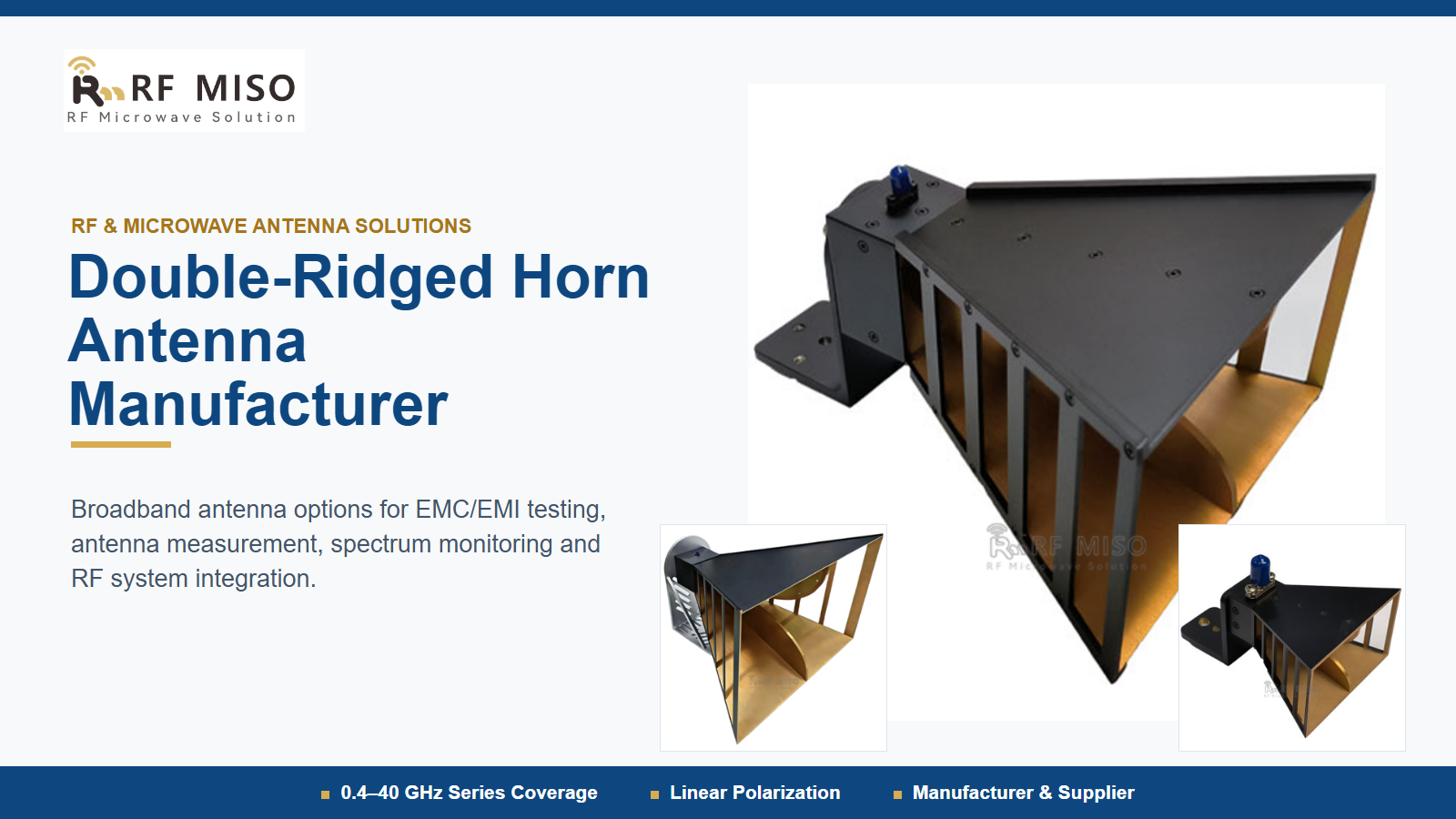
Choosing a double-ridged horn antenna manufacturer is not only a matter of comparing frequency ranges. For broadband RF testing, the antenna must also provide stable impedance matching, predictable radiation behavior, suitable connectors, and mechanical dimensions that fit the measurement setup. These details directly affect repeatability in EMC/EMI testing, antenna measurement, signal monitoring, and system integration.
RF MISO develops and supplies broadband horn antenna solutions for RF engineers, system integrators, laboratories, and equipment manufacturers. The representative models below collectively span 0.4 to 40 GHz, allowing users to select an antenna for a defined operating band rather than assuming that one antenna covers the entire range.
Why Double-Ridged Horn Antennas Are Used for Broadband RF Testing
A double-ridged waveguide structure extends the usable bandwidth of a horn antenna while retaining directional radiation and linear polarization. This combination makes the antenna useful when a test system must operate over a broad frequency range without repeatedly changing antennas.
Typical uses include radiated emissions testing, EMC/EMI evaluation, antenna gain and radiation-pattern measurement, broadband signal transmission and reception, surveillance, reconnaissance, and direction finding. The best model still depends on the required band, desired gain, test distance, available space, connector interface, and power level.
What to Evaluate When Selecting a Manufacturer
1. Frequency coverage based on the real test band
Begin with the lowest and highest operating frequencies required by the system. A wider range is not automatically better: the selected antenna should match the actual test band while meeting the required gain, beamwidth, size, and connector conditions. When several bands are involved, compare the trade-offs between one broadband model and multiple antennas optimized for narrower ranges.
2. Gain and impedance matching
Gain influences link budget and field strength, while VSWR indicates how effectively power is transferred between the feed line and antenna. Published values should be read together with frequency-dependent plots whenever possible. RF engineers should also confirm whether stated values are typical or guaranteed and review the current datasheet for the exact configuration being purchased.
3. Radiation performance and polarization
Broadband coverage alone does not define antenna performance. Radiation patterns, beamwidth, cross-polarization isolation, and linear polarization orientation can be equally important in measurement and monitoring systems. These characteristics help determine test geometry, alignment requirements, and measurement uncertainty.
4. Connector and mechanical integration
Connector type must be compatible with the operating frequency, cable assembly, and test equipment. Overall dimensions, weight, mounting arrangement, and antenna orientation also affect chamber installation, positioning systems, and portable test setups. A current mechanical drawing is essential when the antenna will be integrated into an existing fixture or platform.
5. Manufacturer documentation and technical communication
A capable broadband horn antenna supplier should provide model-specific specifications and clear technical communication. Before ordering, share the required frequency range, application, target gain, connector, power level, mounting constraints, and environmental conditions. This gives the manufacturer enough information to review whether a standard model is suitable.
Representative RF MISO Broadband Horn Antennas
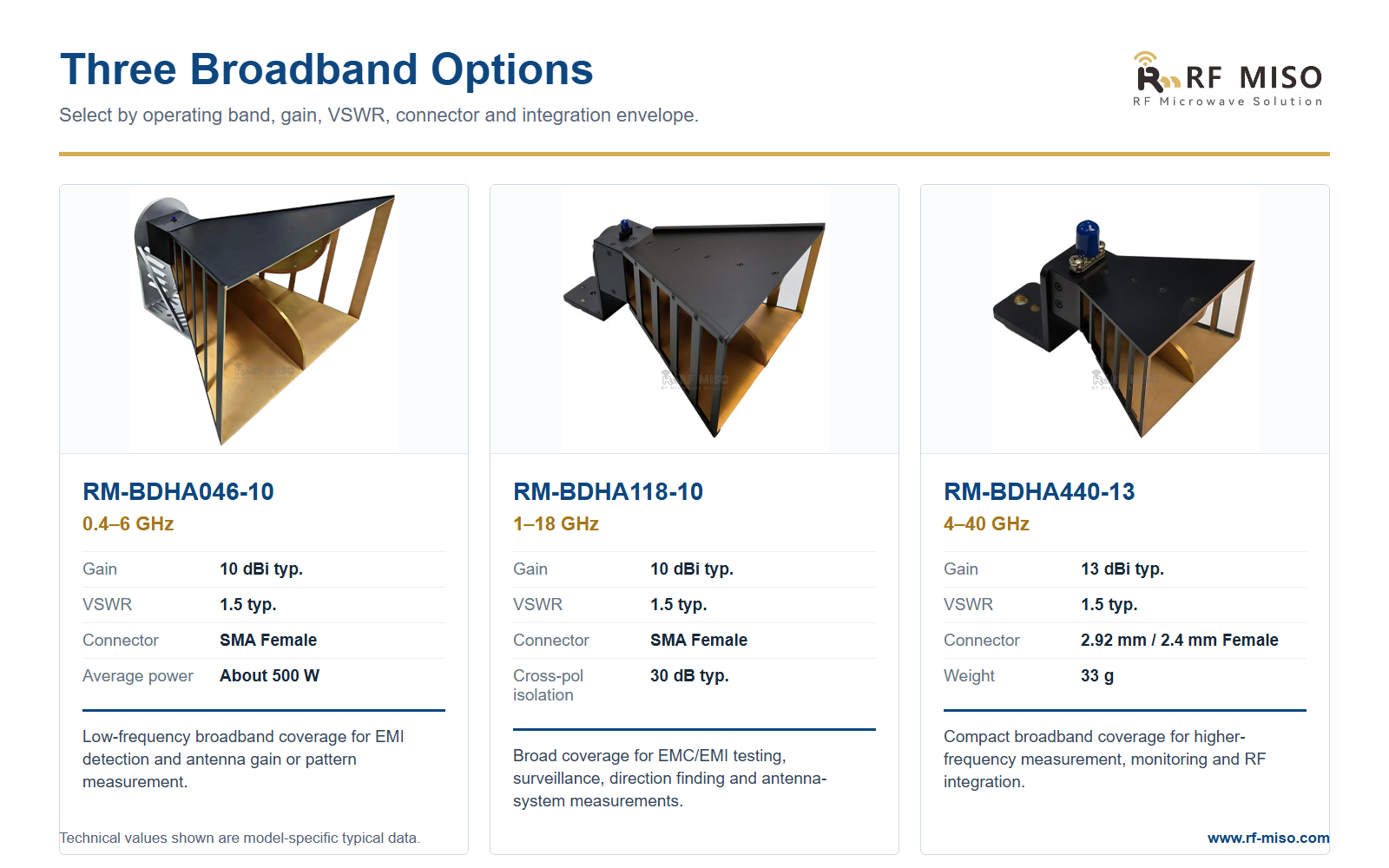
| Model | Frequency Range | Gain | VSWR | Connector | Dimensions (L × W × H) |
|---|---|---|---|---|---|
| RM-BDHA046-10 | 0.4–6 GHz | 10 dBi typ. | 1.5 typ. | SMA Female | 540 × 603.5 × 398.3 mm (±5 mm) |
| RM-BDHA118-10 | 1–18 GHz | 10 dBi typ. | 1.5 typ. | SMA Female | 182.4 × 185.1 × 116.6 mm (±5 mm) |
| RM-BDHA440-13 | 4–40 GHz | 13 dBi typ. | 1.5 typ. | 2.92 mm Female / 2.4 mm Female | 58.3 × 60.4 × 47.7 mm |
RM-BDHA046-10 is intended for lower-frequency broadband work from 0.4 to 6 GHz and has a typical gain of 10 dBi. Its current specification lists linear polarization, 30 dB cross-polarization isolation, an SMA Female connector, and average power handling of approximately 500 W.
RM-BDHA118-10 covers 1 to 18 GHz with 10 dBi typical gain. Its comparatively compact dimensions make it a practical candidate for wideband laboratory systems where coverage through the microwave range is required.
RM-BDHA440-13 extends coverage from 4 to 40 GHz with 13 dBi typical gain. The current configuration offers a 2.92 mm Female or 2.4 mm Female connector and weighs 33 g, supporting higher-frequency measurement and integration tasks where compact size is important.
Specifications above are based on the current model datasheets supplied for this comparison. Confirm the latest datasheet and required configuration with RF MISO before ordering.
Working with RF MISO as an Antenna Manufacturer
RF MISO combines antenna research and development, engineering, production, and sales within one organization. For engineering buyers, direct technical communication helps connect application requirements with a specific model and current documentation. RF MISO supplies antennas for RF and microwave applications, including broadband horn antennas, standard gain horn antennas, corrugated horn antennas, waveguide antennas, and other antenna solutions.
When contacting RF MISO, provide the operating frequency range, intended test or system application, preferred connector, gain target, power requirement, mounting limits, and any required measurement data. The technical team can then review the available models and help identify an appropriate starting point.
Frequently Asked Questions
What is the difference between a double-ridged horn and a standard gain horn?
A double-ridged horn is generally selected for broad frequency coverage. A standard gain horn is commonly used over a narrower waveguide band when a well-defined gain reference is required. The correct choice depends on bandwidth, gain, pattern, test method, and calibration requirements.
Can one RF MISO antenna cover 0.4 to 40 GHz?
No. The 0.4–40 GHz figure describes the collective coverage of the representative models in this article. Each antenna has its own specified operating band, so users should select a model based on their actual frequency range.
What information should I send to a horn antenna manufacturer?
Provide the minimum and maximum frequency, application, gain requirement, polarization, connector, power level, installation space, mounting method, and any required test data. Complete requirements reduce selection errors and speed up technical review.
Which model should I choose for wideband testing?
The answer depends on the band and setup. RM-BDHA046-10 addresses 0.4–6 GHz, RM-BDHA118-10 covers 1–18 GHz, and RM-BDHA440-13 covers 4–40 GHz. Gain, connector, dimensions, power, and radiation performance should also be reviewed before selection.
Explore RF MISO Broadband Horn Antennas
Compare additional models or contact RF MISO with your frequency range and integration requirements.
Post time: Sep-10-2026


