Circularly polarized horn antenna history
Circularly polarized horn antenna is an important antenna type with a wide range of applications, including communications, radar, satellite communications and radio measurement. The following is a historical introduction to circularly polarized horn antennas:
From the late 1940s to the early 1950s, the concept and design of circularly polarized horn antennas began to appear. During this period, antenna engineers began to realize that traditional linearly polarized antennas had limitations in certain applications. So, they began to research and explore the concept of circularly polarized antennas to achieve better signal transmission and reception performance.
In 1958, Paul G. Montgomery, an engineer at Radar Systems Corporation in the United States, designed a horn antenna with circular polarization characteristics, called the Montgomery Antenna. This was the first successful implementation of a circularly polarized horn antenna and attracted widespread attention and research.
In the following decades, circularly polarized horn antennas have been extensively researched and developed. Engineers have conducted extensive experiments and theoretical analyzes in designing and optimizing the structure and performance of circularly polarized horn antennas.
In the 1960s, circularly polarized horn antennas were widely used in the communications field. The advantage of the circularly polarized horn antenna is that it can achieve better signal coverage and anti-interference capabilities, and is especially suitable for multipath propagation environments in wireless communication systems.
In the 1980s and 1990s, with the further development of satellite communications and radar technology, the application range of circularly polarized horn antennas was further expanded. Circularly polarized horn antennas are widely used in satellite communication ground stations, radar systems, and military and aviation fields.
With the continuous advancement of electronic technology, the design and manufacturing process of circularly polarized horn antennas have also been improved. Modern circularly polarized horn antennas use advanced materials and manufacturing techniques to provide higher operating frequency ranges, better performance and smaller sizes.
How does a circularly polarized horn antenna work
Circularly polarized horn antennas achieve circularly polarized radiation characteristics mainly through their special geometry and design. The working principle of this antenna is based on the following key features:
Horn shape: Circularly polarized horn antennas usually adopt a horn-shaped radiator structure. The design of the horn antenna causes the signal to continuously diffuse inside the horn, thereby forming a specific radiation characteristic that can meet the requirements of circular polarization.
Cross-coupler: A special cross-coupler is usually installed inside the horn antenna to couple the horizontal and vertical electric field components with a phase difference of 90 degrees. This design allows the antenna to produce a circularly polarized radiation pattern.
Multi-mode radiation: The design of a circularly polarized horn antenna enables it to radiate multiple modes of electromagnetic fields simultaneously, including circularly polarized signals rotated in different polarization directions.
Currently, circularly polarized horn antennas are widely used in various application scenarios, including satellite communications, mobile communications, radio measurement, aerospace, radar, and drones.
Related Products
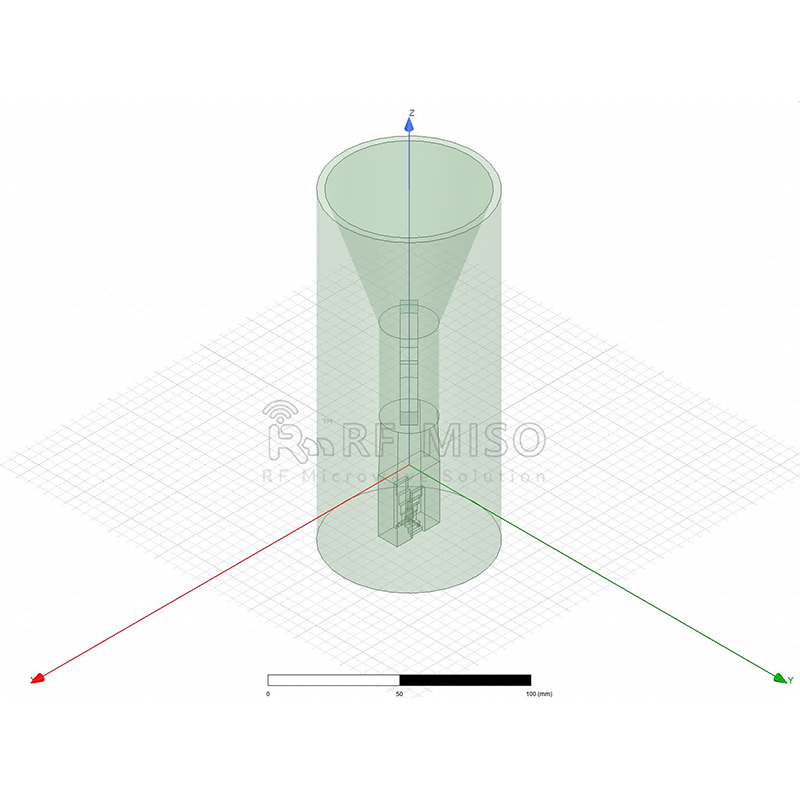
RM-CPHA95105-16,9.5-10.5GHz
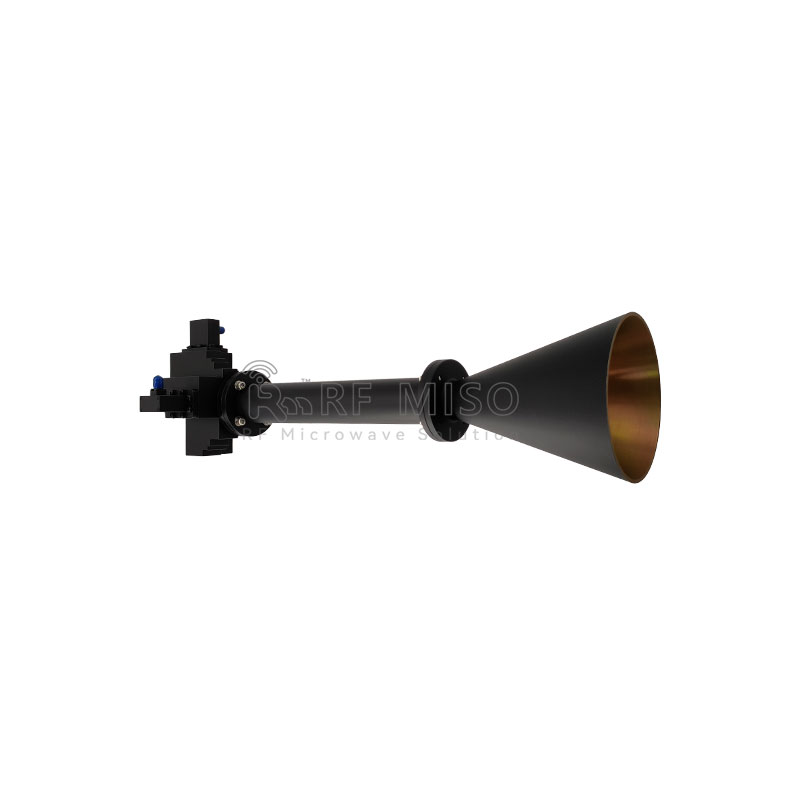
RM-DCPHA105145-20,10.5-14.5GHz
RM-DCPHA48-12,4-8GHz